
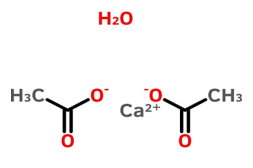
Calcium Acetate Monohydrate molecule contains one calcium cation (Ca²⁺) and two acetate anions (CH₃COO⁻) with one molecule. It contains two positive anions in Calcium Acetate. It carries one negative charge and one water molecule.
The Acetate ion itself consists of a methyl group (CH₃) attached to a carboxylate group (COO⁻), where the negative charge is over the two oxygen atoms.
Calcium Acetate Monohydrate is produced by reacting with aqueous solution and limestone.
This process is mostly preferred process in production.
| Application Category | Calcium Acetate Monohydrate End Use |
|---|---|
| Pharmaceutical Industry |
|
| Lab Industry |
|
| Food Industry |
|
| GRAS (Generally Recognized as Safe) Uses |
|
| Lubricants and Greases Industry |
|
| Wastewater treatment |
|
| Textile Industry |
|
| Food Category | Maximum permitted level in foods | As Per |
|---|---|---|
| As a Preservative, stabilizer, acidity Regulator | GMP | FSSAI |
| In baked goods | 0.2% | GRAS |
| For Cheese making | 0.02% | GRAS |
| For Gelatins, Puddings, and Fillings | 0.2% | GRAS |
| For Sweet Sauces, Toppings, and Syrups | 0.15% | GRAS |
| For all other food categories. | 0.0001% | GRAS |